
Traffic Sign Reflectivity & Retroreflectivity Sheeting
Retroreflective sheeting makes traffic signs visible at night by reflecting light from vehicle headlights back toward the driver.
Cheap Street Signs offers three grades of reflective sheeting so you can match the material to your application, project specifications, and visibility requirements. All of our signs are available in durable .080" rust-resistant aluminum with reflective sheeting applied to the sign face.
| Comparison at a Glance | Engineer Grade Prismatic | High Intensity Prismatic | Diamond Grade DG3 |
|---|---|---|---|
| ASTM D4956 Type | Type I | Type III / Type IV | Type XI |
| 3M Series | 3430 | 3930 | 4000 |
| Stated performance life | 7 years | Up to 10 years | Up to 12 years |
| Relative nighttime visibility | Standard | High | Maximum |
| Typical applications | Parking, property, commercial, non-critical | Roadway, regulatory, warning, guide, street name | Demanding roadway, high-speed, Type XI specifications |
| Relative cost | Most economical | Mid-range | Premium |
Engineer Grade Prismatic - ASTM Type I
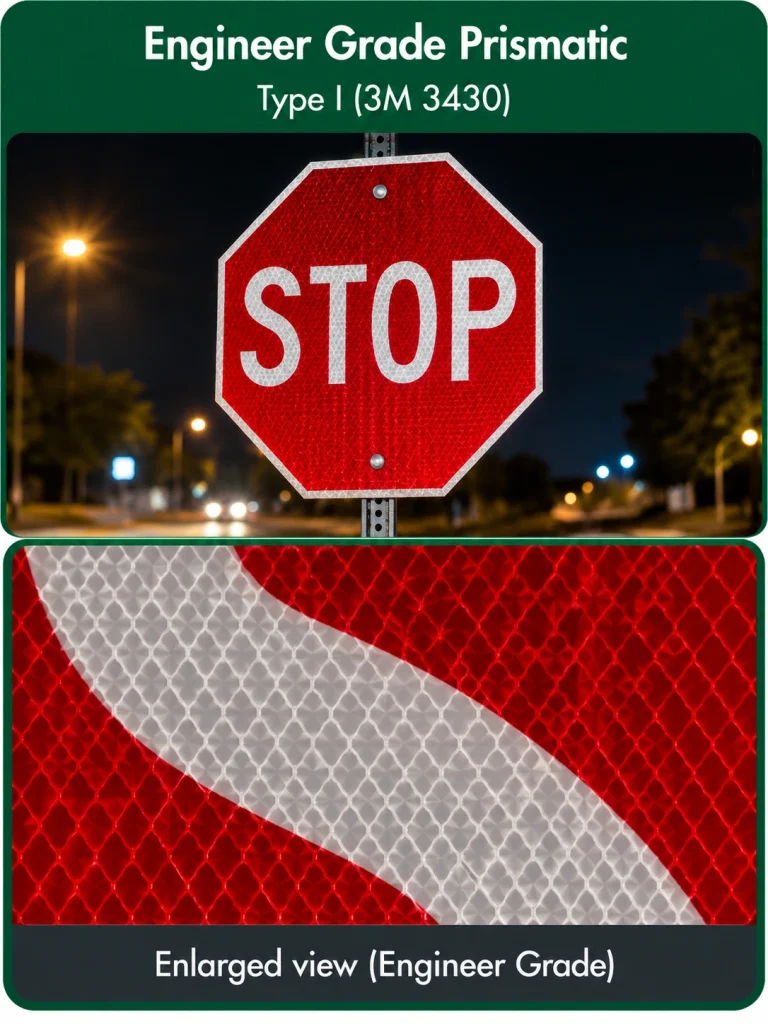
Engineer Grade Prismatic reflective sheeting provides economical nighttime visibility for many non-critical traffic, parking, property, and commercial sign applications.
3M Engineer Grade Prismatic Series 3430 meets or exceeds ASTM D4956 Type I specifications and has a stated performance life of seven years.
Best suited for: General-purpose and non-critical sign applications where Type I sheeting satisfies the applicable requirements.
High Intensity Prismatic - ASTM Type III/IV
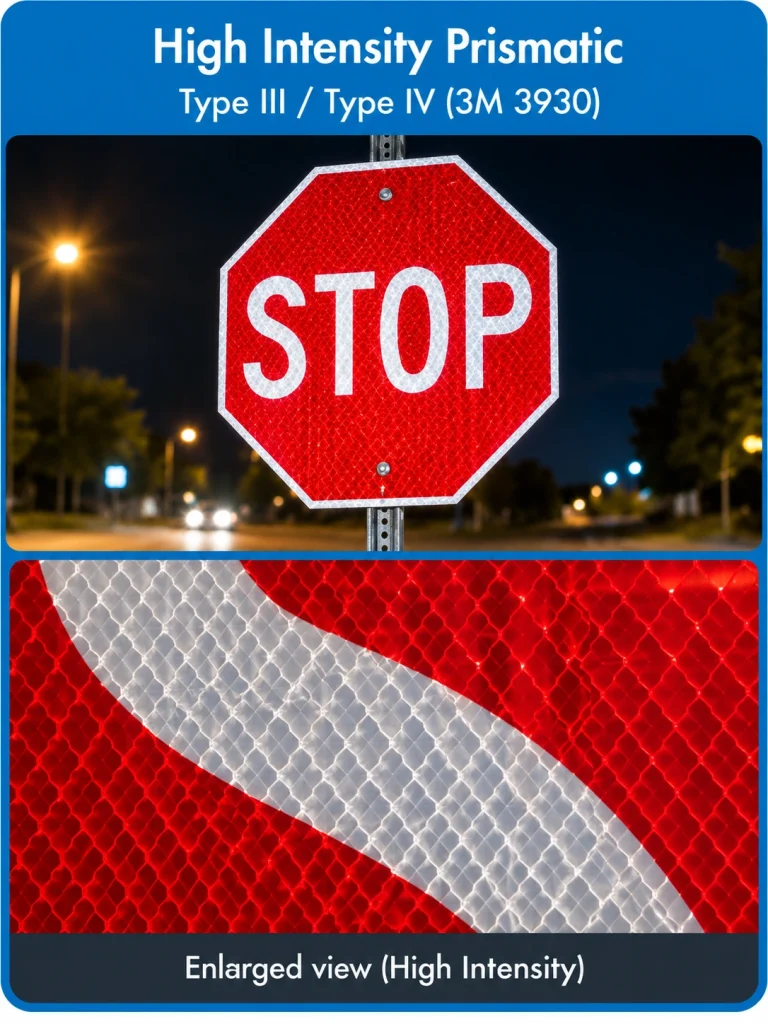
High Intensity Prismatic reflective sheeting provides substantially greater nightime visibility than Engineer Grade and is commonly used for regulatory, warning, guide, street name, and other traffic-control signs.
3M High Intensity Prismatic Series 3930 meets ASTM D4956 Type IV requirements and is warranted for up to 10 years under applicable 3M warranty conditions.
If your project specification calls for Type III material, higher-performing sheeting may satisfy the performance requirement, but always confirm the specification itself since some agencies call for a particular ASTM type.
Best suited for: Roadway and traffic-control applications requiring higher retroreflectivity and improved nighttime visibility.
Diamond Grade DG³ - ASTM Type XI
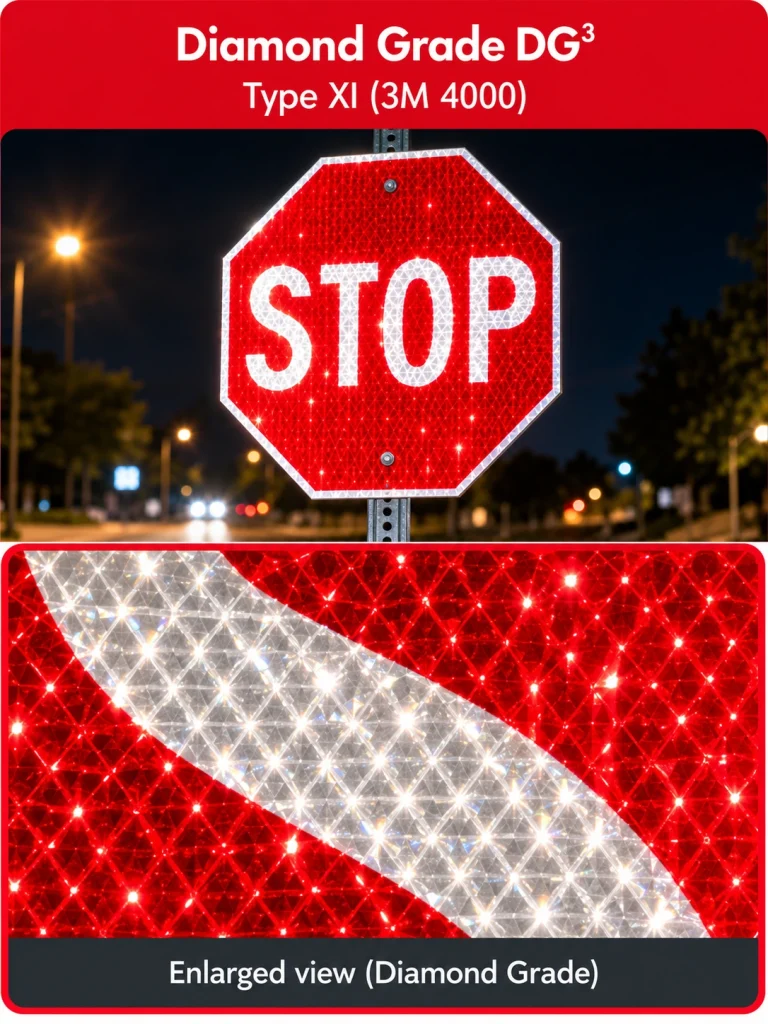
Diamond Grade DG³ is 3M's high-performing full-cube retroreflective sheeting. It is designed to return more available light toward drivers across a broad range of viewing distances and entrance angles.
3M Diamond Grade DG³ Series 4000 meets ASTM D4956 Type XI specifications and is available with warranty coverage of up to 12 years when applicable 3M system requirements are met.
Best suited for: Maximum nighttime visibility, high-speed roadways, long-term performance, or Type XI sheeting is specified.
3M, Diamond Grade, and DG3 are trademarks of 3M Company.

Illustrative comparison of 3M Engineer Grade Prismatic, High Intensity Prismatic and Diamond Grade DG3 reflective sheeting brightness levels at night.
Fluorescent Sheeting
Some signs call for a fluorescent sheeting color rather than a standard color. Fluorescent materials convert ultraviolet light into visible light, making them noticeably brighter during daylight, dawn and dusk, and overcast conditions. They are retroreflective at night as well.
Fluorescent color is a separate consideration from sheeting grade — you are selecting both a color and a performance level.
Fluorescent Yellow-Green
Designated by the MUTCD for pedestrian, bicycle, playground, school bus, and school warning applications. Depending on the particular sign, fluorescent yellow-green may be required or permitted as an alternative to standard yellow.
Fluorescent Orange
This color may be used for temporary traffic-control and work-zone applications where permitted.
Fluorescent Pink
This color is designated for incident-management signing, such as temporary traffic control associated with crashes and other unplanned roadway incidents.
Understanding MUTCD Reflectivity Requirements
The Federal Highway Administration's Manual on Uniform Traffic Control Devices (MUTCD) establishes standards for traffic-control devices used on streets, highways, bikeways, and site roadways open to public travel.
The current federal version is the 11th Edition with Revision 1, dated December 2025 and effective March 5, 2026. States may adopt the federal MUTCD directly, use a state supplement, or maintain a state manual in substantial conformance with the federal requirements. Always confirm which requirements govern your particular project.
The MUTCD requires applicable traffic signs to be retroreflective or illuminated and establishes minimum maintained retroreflectivity levels. These are the levels a sign must continue to meet while in service, not simply when it is new.
Minimum requirements vary according to factors including sign color, sign type, mounting location, and retroreflective material.
Compliance is therefore not a matter of declaring one sheeting type acceptable for every sign and another unacceptable. The appropriate material depends on the particular sign, application, and applicable specification.
Traffic Signs on Private Property
The MUTCD can also apply to certain privately owned roadways.
Site roadways open to unrestricted public travel can include roads within shopping centers, office parks, airports, schools, universities, sports facilities, recreational facilities, and similar properties. The owners or parties responsible for those roadways are responsible for the traffic-control devices installed on them.
There is an important distinction: parking areas and the driving aisles within parking areas are specifically excluded from the federal MUTCD definition of roadways open to public travel.
State, local, accessibility, building-code, fire-code, or other requirements may still apply to signs within parking areas. Accessible parking signage, in particular, is subject to separate requirements.
Which Reflectivity Level Should I Choose?
The right sheeting grade depends on your application, project specifications, and visibility requirements.
- Engineer Grade Prismatic — an economical choice for parking, property, commercial, and non-critical applications where project requirements permit it.
- High Intensity Prismatic — a strong general-purpose choice for roadway traffic-control signs and applications requiring increased nighttime visibility.
- Diamond Grade DG³ — a premium choice for demanding roadway applications, high-speed corridors, maximum nighttime visibility, or projects that specify Type XI material.
When signs are being purchased for a public agency, DOT project, roadway, or other regulated installation, always follow the applicable MUTCD requirements, state or local requirements, and project specifications.
Available grades vary by sign type. Not every sign is produced in all three grades. The reflective options available for a particular sign are shown on its product page, along with the price for each option.
Common Questions
What is the practical difference between Engineer Grade and High Intensity Prismatic?
High Intensity Prismatic is designed to provide greater retroreflectivity than Engineer Grade, improving nighttime visibility across a wider range of roadway conditions. Engineer Grade is appropriate where visibility demands are more modest and the applicable specification permits Type I. High Intensity is a common choice for roadway traffic-control signs requiring greater nighttime visibility.
How long does reflective sheeting last?
3M states a performance life of seven years for Engineer Grade Prismatic, with warranty coverage of up to 10 years for High Intensity Prismatic and up to 12 years for Diamond Grade DG³ under applicable warranty conditions. Actual service life can vary with exposure, orientation, climate, installation, and maintenance.
Do I need reflective signs on private property?
It depends on the location. If a roadway is open to unrestricted public travel, MUTCD requirements can apply even though the road is privately owned. Parking areas and their driving aisles are excluded from the federal MUTCD definition, although state, local, accessibility, and other requirements may still apply.
Can I use different sheeting grades on the same project?
Potentially, yes. Project specifications may permit or require different grades depending on the sign type, roadway, location, or application. Check the applicable specification before selecting or mixing grades.
What does the ASTM Type number mean?
ASTM D4956 is the standard specification used to classify retroreflective sheeting for traffic-control applications. The different types identify defined performance characteristics for the sheeting. A higher type number does not necessarily mean simply "brighter" under every viewing condition, which is why project specifications typically identify the required ASTM type.
The information on this page is provided for general purchasing guidance and is not engineering, legal, or compliance advice. Always follow the specifications and regulatory requirements that apply to your project.